





























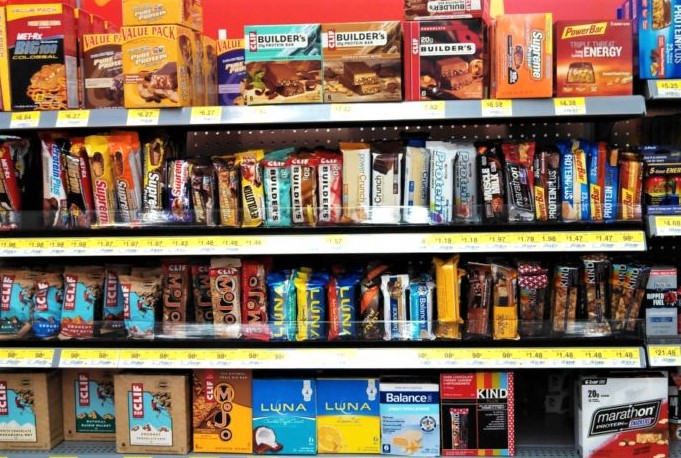
Protein bars are now everywhere. There’s an aisle filled with them in your local supermarket. But, unlike protein powders, protein bars were not an immediate hit, despite their long history. Partly this was a matter of taste—the more protein they had the worse they tasted—but it was also a matter of marketing. Most were sold as “nutrition bars” or “energy bars.” In fact, the term “protein bar” didn’t come into vogue until this century, even though protein supplement companies were making bars a half-century earlier. Let’s journey through the sometimes tasty, but often not, amazing history of protein bars.
HOFFMAN HI-PROTEEN FUDGE AND COOKIES
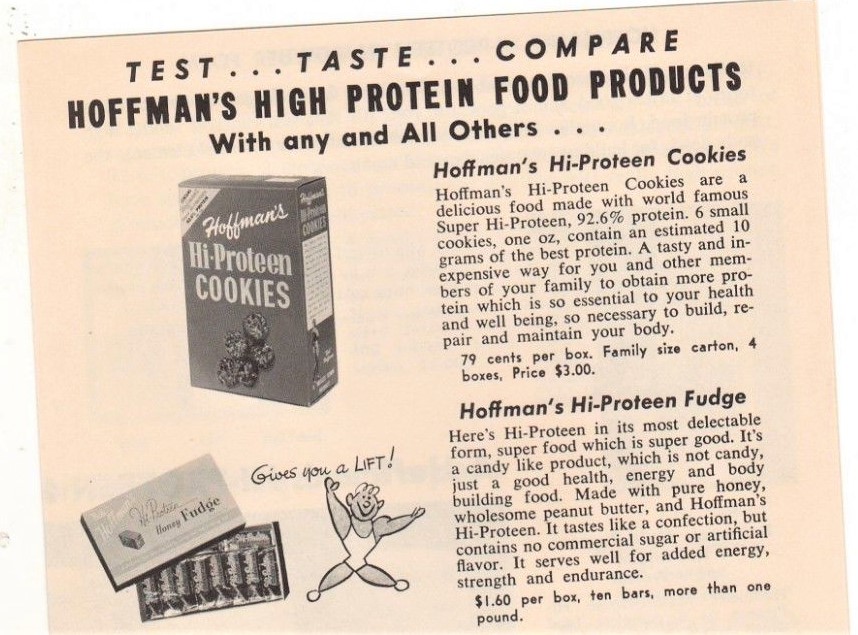
In 1952, Bob Hoffman, the Pennsylvania weightlifting mogul of York barbells and Strength and Health magazine, launched his own soy-based protein powder and pills. It was the dawn of a protein craze in the lifting community. Distinguishing his brand in the new and crowded market, Hoffman, whose company was based just 23 miles from the “World Chocolate Capital” of Hershey, Pennsylvania, launched Hi-Proteen Honey Fudge and Hi-Proteen Cookies, circa 1953. He also sold Hi-Proteen bread. (Yes, that was the spelling.) As for the fudge, ten “candy like” bars came in a box, like fine chocolates. We’re unsure how much, if any, chocolate was included, because, according to Hoffman, the ingredients were his soy protein powder, peanut butter, and honey. As for the cookies, six of them had an estimated 10 grams of Hoffman’s soy protein.
WEIDER PROTEIN BAR
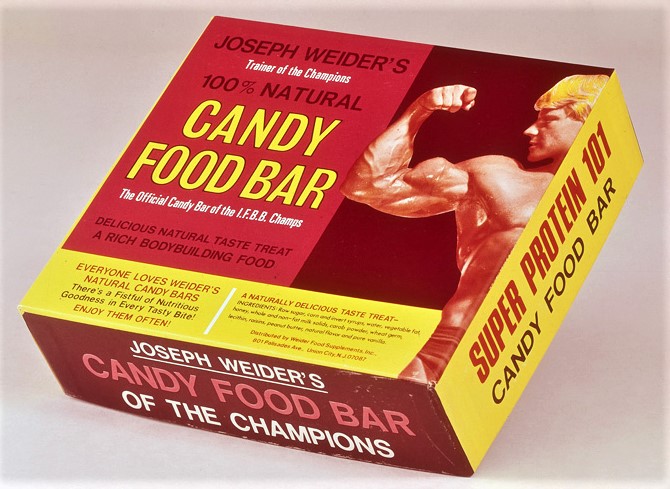
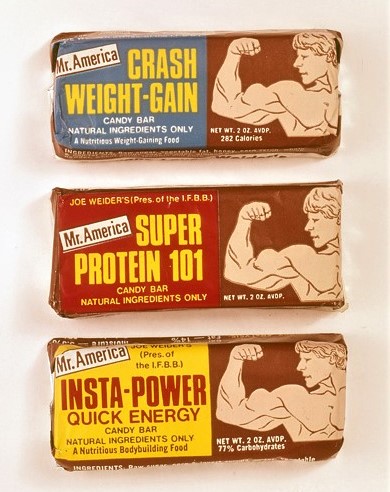
The other muscle mogul, Joe Weider, who was more focused on bodybuilding than Hoffman was, launched his Candy Food Bar in the late 1960s, and like Hoffman’s sweets they didn’t last long. There were three of them: Mr. America Crash Weight-Gain, Mr. America Super Protein 101, and Mr. America Insta-Power Quick Energy. Dubbed “The Official Candy Bar of the I.F.B.B. Champs” [IFBB = International Federation of Bodybuilders] and sporting a likeness of Mr. America and Mr. Universe Dave Draper on each package, these were the true precursors to modern protein bars.
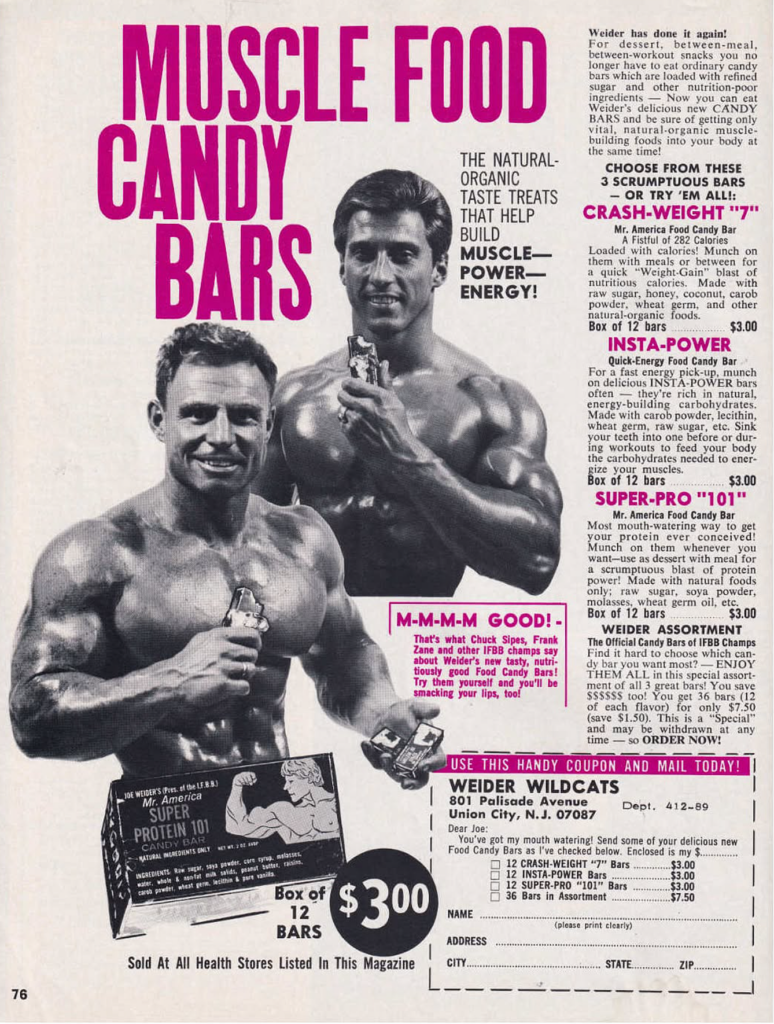
But did they have much protein? There were no nutrition statistic labels then, but here were the ingredients for Super Protein 101 (on the box): raw sugar, corn syrup, water, vegetable fat, honey, whole and non-milk solids, carob powder, wheat germ, lecithin, raisins, peanut butter, natural flavors and pure vanilla. The best you can say is the bars had no artificial preservatives, but they were loaded up with a lot of unhealthy (but sweet) ingredients before whatever protein there was in the milk solids. Crash Weight-Gain had a whopping 282 calories per 2 oz. bar. By comparison, a modern 1.86 oz. Snickers bar has 250 calories.
FOOD STICKS
Pillsbury’s Space Food Sticks were based on bars, also made by Pillsbury, eaten by astronauts in the 1960s. These thin bars (chocolate, caramel, and peanut butter) were simply, but unappetizingly, rebranded Food Sticks in 1971 and advertised as “an energy snack that gives you the balanced nutrition of a miniature meal.” Just as NASA-favorite Tang was a precursor of modern energy drinks, the mainstream appeal of space age Food Sticks brought energy bars to the general public in the 1970s.
TIGER’S MILK
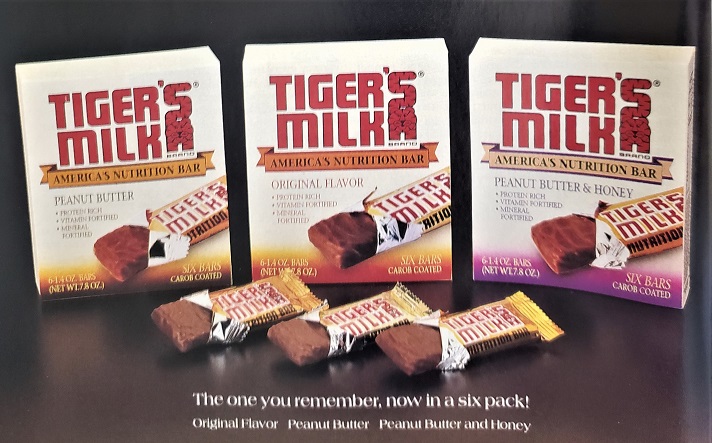
In the 1960s, Tiger’s Milk bars were launched by James and Arthur Ingoldsby. Unlike Food Sticks, Tiger’s Milk nailed the naming. With twice as much sugar as protein, the bars were bland but palatable. The company was purchased by Weider in the 1980s, and for a new generation it was the go-to “nutritious” snack bar. No time for breakfast? Grab a Tiger’s Milk. In 2017, the brand sold again. A 2019 lawsuit claimed traditional Tiger’s Milk bars, with only 6 grams of protein, were misleadingly advertised as high protein. The lawsuit failed, but so did the bar’s rebranding in today’s crowded, high-protein marketplace. America’s longest lived nutrition bar finally died in 2022.
POWER BAR & CLIF BAR
Power Bar, was started in 1986 by a marathoner, who said, “I’m creating the perfect energy bar, to help athletes survive long-distance events without running out of glycogen.” Though it had three times as much sugar (21 g.) as protein (7 g.), it sounded like something to boost deadlifts. Power Bar would later make higher protein (20 g.), lower sugar (12 g.) bars, though that ratio is still not ideal.
Similarly, Clif Bar was created in 1992 by a cyclist and marketed to outdoor adventurers. It, too, eventually birthed a popular line of higher-protein (20 g.) bars (named Builders) for those more focused on reps than miles. Tiger’s Milk, Power Bar, and Clif Bar were usually your only protein bar options in health food stores until the mid-’90s, when bars targeted specifically to bodybuilders began impacting the market.
MODERN PROTEIN BARS
The modern protein bar came into vogue in the late 1990s, though the term only took off a decade later. Let’s look at a 10-year progression.
◼ The August 1998 FLEX magazine has ads for seven bars: Bio X, Protein 21, White Lightning, ProMax, Steel, Core, and Triathlon. Two of those made note of their 27 grams of protein.
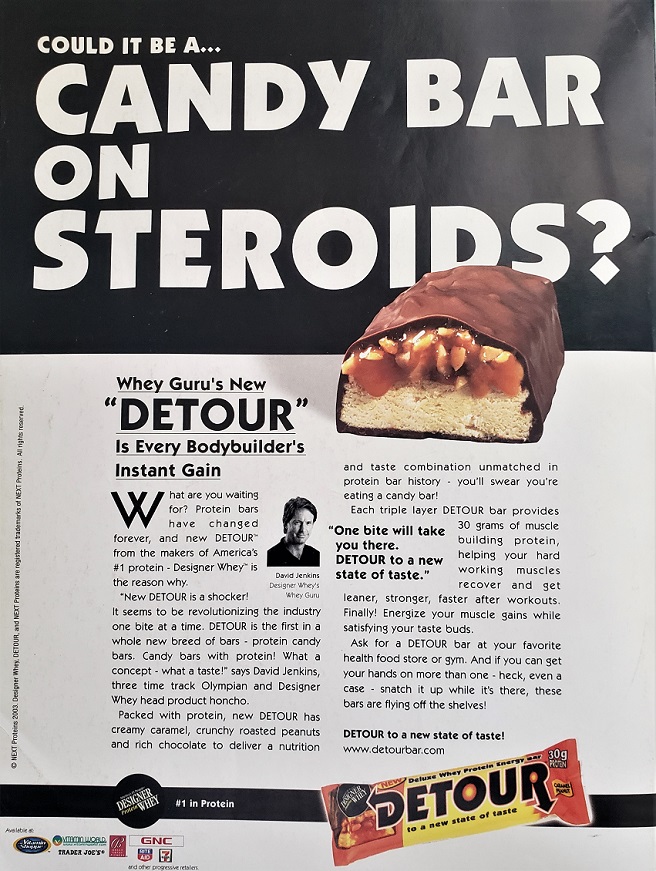
◼ Five years later in the August 2003 FLEX, there were six bars advertised: Detour, U-Turn, Labrada’s Lean Body Gold, Steel, Pure, and Meso-Tech. The term “protein bar” was still not in wide use. Meso-Tech was a “Meal Replacement Energy Bar,” U-Turn was at least called a “Protein Energy Bar,” and the ad for Detour asked if it was a “Candy Bar on Steroids?”
◼ After another five years, the focus was, finally, squarely on protein, and lots of it. The four ads in the August 2008 FLEX each note the 30 to 33 grams of protein per bar and all featured “protein” or “pro” in their names: Pure Protein High Protein, Supreme Protein Carb Conscious, Promax, and Protein 32. The latter, formerly Protein 21, had boosted its protein over 50% in a decade. The modern protein bar had come of age.
Since then, protein bars have broken out of the bodybuilding community and, like energy bars before them, gone mainstream. By the time most of the muscle magazines went under, the bars that used to fill those pages with ads were everywhere, including such currently popular brands as Pure Protein (launched in 1995), Power Crunch (launched in 2003), and Quest (launched in 2010). Seven decades after Hoffman’s fudge, protein is the hot marketing term associated with all sorts of packaged foods, most especially candy bars.